RCCB Breaker Price Installation Lahore Guide

A small earth leakage fault can turn a normal switch, geyser, washing machine, water pump, or metal appliance body into a serious shock hazard. That is why an RCCB is not just another item in the distribution board. It is a life safety device.
For many Lahore homes, shops, offices, and rental portions, the main question is simple: what does an RCCB cost, and what should proper installation include? In 2026, a typical RCCB breaker with installation in Lahore often falls between PKR 4,500 and PKR 8,000, depending on brand, rating, wiring condition, DB space, and service requirements.
LahoreFix.com provides RCCB supply and installation support in Lahore and can guide you on suitable options such as Schneider and Hager breakers. For booking or advice, call 0305-1717571.

RCCB breaker price installation Lahore kitni hai
The common price range for RCCB Breaker Price Installation Lahore in 2026 is around PKR 4,500 to PKR 8,000 for many standard residential jobs. This range usually covers the RCCB unit and basic installation, but the final cost can change after checking the site.
A safe electrician should inspect the following before giving a final quote:
Existing DB condition
Available space in the distribution box
Single-phase or three-phase supply
Load requirement
Neutral wiring condition
Earthing availability
Brand and ampere rating needed
Extra cable, lugs, glands, or DB parts if required
A low price may look attractive, but it can become risky if the breaker is fake, undersized, poorly wired, or installed without testing. RCCB installation is not the place to cut corners.
Common 2026 price guide in Lahore
RCCB installation type | Expected price range in Lahore | Suitable for |
Basic single-phase RCCB installation | PKR 4,500 to PKR 6,000 | Small homes, portions, small shops |
Branded RCCB with standard installation | PKR 6,000 to PKR 8,000 | Homes using Schneider, Hager, or similar quality brands |
Larger DB or extra wiring work | Site-based quote | Old wiring, damaged DB, multiple circuits |
Three-phase RCCB setup | Site-based quote | Commercial loads, larger houses, workshops |
These are practical market-style estimates, not a fixed universal rate. A technician may need to check the wiring before confirming the exact cost.
What an RCCB does in simple words
RCCB stands for Residual Current Circuit Breaker. It monitors current going out through the live wire and current returning through the neutral wire. Under normal conditions, both should match.
If some current leaks through a faulty appliance, wet surface, damaged cable, or a person touching a live metal part, the RCCB detects the difference and trips the circuit.
A common 30 mA RCCB used for human protection can trip very quickly, often within a fraction of a second under fault conditions. Many people describe this as around 0.03 second, though actual trip time depends on the device type and fault level.
That fast disconnection is what makes RCCB protection so valuable. It does not make electricity harmless, but it can reduce the risk of severe electric shock.
An RCCB is designed to disconnect power when leakage current is detected. It is a safety backup, not a replacement for proper wiring, earthing, and careful appliance use.
RCCB and MCB are not the same
Many homes already have MCBs in the DB, so people assume they are fully protected. An MCB and an RCCB do different jobs.
Device | Protects against | Main purpose |
MCB | Overload and short circuit | Protects wiring and equipment from excess current |
RCCB | Earth leakage current | Helps protect people from electric shock |
RCBO | Overload, short circuit, and leakage | Combines MCB and RCCB functions for one circuit |
An MCB may not trip during a leakage fault if the leakage current is too small to trigger overload protection. That is where an RCCB helps.

Why RCCB installation is necessary in Lahore homes
Lahore homes often use many high-load and metal-body appliances. Geysers, washing machines, water motors, microwave ovens, air conditioners, refrigerators, and water dispensers all need safe wiring.
The risk becomes higher when there is:
Moisture near electrical points
Old wiring in walls
Loose neutral connections
Poor earthing
Damaged extension boards
Low-quality sockets
Shared loads in rental portions
DIY electrical repairs
Water pump wiring exposed to damp areas
Children, older people, and anyone standing barefoot on a wet floor face greater danger from leakage current. That is why RCCB installation is often recommended in homes where water and electricity come close together, such as bathrooms, kitchens, rooftops, laundry areas, and pump rooms.
RCCB helps protect families
An RCCB can be called a “jaan bachane wala breaker” because it is designed to cut power when electricity leaks where it should not go. For family homes, especially where children touch switches, play near appliances, or use chargers, this extra layer of protection matters.
It is especially useful for:
Electric geysers
Instant heaters
Washing machines
Bathroom circuits
Kitchen sockets
Water pumps
Outdoor lighting
Rooftop circuits
Shops with metal counters or machines
No breaker can promise total protection in every situation, but a properly selected RCCB can greatly improve electrical safety when combined with correct wiring and earthing.
Choosing the right RCCB brand and rating
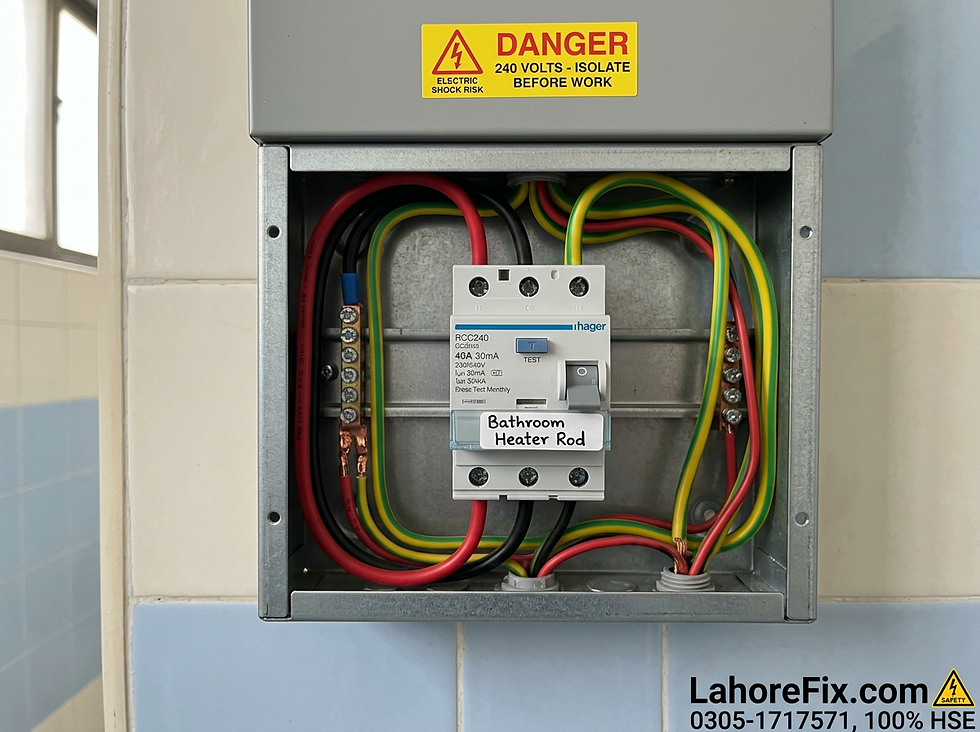
LahoreFix.com commonly recommends original branded RCCBs such as Schneider and Hager, depending on availability, budget, and the electrical load. The key point is originality. Fake or copied breakers may look similar from the outside but fail when needed.
A proper technician should select the RCCB based on actual site conditions, not guesswork.
Common RCCB ratings
For many single-phase homes, electricians often use RCCBs in ratings such as:
25 A
40 A
63 A
The right rating depends on the total connected load and main breaker size. A breaker that is too small can trip unnecessarily. A breaker that is not suitable for the system can create safety and reliability issues.
For human safety, many homes use a 30 mA sensitivity RCCB. Other sensitivities may be used for different applications, but domestic shock protection commonly uses 30 mA.
Two-pole and four-pole RCCB
A single-phase supply usually needs a two-pole RCCB, which disconnects live and neutral.
A three-phase supply usually needs a four-pole RCCB, which disconnects three phases and neutral.
This is one reason three-phase jobs cost more. The device is different, installation takes more care, and load balancing may also need checking.
What proper RCCB installation should include
A good RCCB installation is more than fitting a breaker into the DB. The electrician should inspect, connect, tighten, test, and explain.
Here is what a safe installation process usually includes.
Site inspection
The technician checks the main supply, DB space, breaker condition, wire size, neutral bar, and earthing setup. This step helps avoid wrong breaker selection.
DB power isolation
Power must be safely turned off before work starts. A trained electrician does not work casually on a live board.
Correct wiring connection
The incoming live and neutral should pass through the RCCB as per the device diagram. Output should feed the protected circuits correctly. Neutral mixing can cause nuisance tripping or unsafe results.
Terminal tightening
Loose terminals cause heating, sparking, and failure. A safe electrician checks that conductors sit properly inside terminals and that screws are tightened firmly.
Trip button test
Every RCCB has a test button, often marked `T` or `TEST`. The electrician should press it after installation to confirm the device trips.
Leakage and load check
If the RCCB trips again and again, there may be a leakage fault in wiring or an appliance. A technician should find the cause rather than bypassing the RCCB.

Signs that you should install or replace an RCCB
Some homes do not have an RCCB at all. Others have one installed years ago but never tested. If any of the following signs apply, arrange an inspection.
Mild shock from appliances
Shock from taps, metal sinks, or geyser body
Burning smell from DB
Old ceramic fuses still in use
Frequent sparking in sockets
Water pump wiring exposed to moisture
Unknown breaker brand installed
Test button does not trip the RCCB
RCCB trips only after rain or during wet conditions
Breaker body looks melted, cracked, or discoloured
Never ignore a small shock. A small warning today can point to a bigger fault inside wiring or an appliance.
Why some RCCBs trip again and again
People sometimes blame the RCCB when it trips, but repeated tripping usually means the device is detecting a real problem. Bypassing it may remove the nuisance, but it also removes protection.
Common reasons include:
Faulty geyser element
Water leakage inside motor or pump
Damaged washing machine wiring
Moisture inside outdoor light fittings
Neutral and earth mixing
Shared neutral between circuits
Poor insulation in old wiring
Wrong RCCB connection
Undersized or low-quality device
A trained electrician can isolate circuits one by one and locate the source. Replacing the RCCB without checking the fault may not solve the problem.
Original breaker matters more than cheap installation
A fake or low-grade RCCB can be dangerous because it may fail silently. It may look fine in the DB, but during leakage it might not trip correctly.
When buying or installing an RCCB, check:
Brand packaging
Clear printing on the device
Proper ampere and mA rating
No spelling mistakes or rough casing
Smooth switch movement
Working test button
Invoice or service record where possible
Schneider and Hager are widely known electrical protection brands. Still, brand name alone is not enough. The unit must be original, correctly rated, and properly installed.
RCCB installation for homes, shops, and rental portions
RCCB installation is not only for large houses. Small rental portions, shops, salons, clinics, food points, workshops, and offices also need earth leakage protection.
A small shop may have refrigerators, freezers, metal counters, UPS systems, neon signs, or outdoor lights. A rental portion may have shared wiring and unclear circuit separation. In both cases, proper inspection is necessary before fitting one RCCB on all circuits.
For some properties, one main RCCB is enough. For others, separate protection for selected circuits works better. For example, a bathroom geyser circuit, kitchen circuit, and outdoor circuit may need special attention.
What to ask before booking an RCCB service
Before calling an electrician, it helps to share basic information. This saves time and allows a more accurate estimate.
Keep these details ready:
Single-phase or three-phase connection
Approximate main breaker rating
Number of floors or portions
Whether the DB has free space
Any appliance giving shock
Any recent wiring work
Whether the RCCB already exists
Preferred brand, if any
For LahoreFix.com service, call 0305-1717571 and describe the issue clearly. If possible, take a clear photo of the DB from a safe distance. Do not open the DB cover yourself if you are not trained.

Simple RCCB maintenance after installation
Once installed, an RCCB needs basic checking. The test button should be pressed regularly, often once a month, to confirm the trip function works. Pressing the test button will cut power to the protected circuits, so do it at a suitable time.
Basic care tips:
Keep the DB dry
Do not cover the DB with cloth or plastic
Do not overload sockets
Replace damaged plugs and extension boards
Fix appliances that give even mild shock
Call a technician if the RCCB trips repeatedly
Never bypass the RCCB to “solve” tripping
If the test button does not trip the RCCB, arrange replacement or inspection. A non-working safety device gives false confidence.
Final takeaway
An RCCB is one of the most useful safety upgrades for a Lahore property. The expected 2026 cost for many standard RCCB installations is around PKR 4,500 to PKR 8,000, but the right choice depends on brand, rating, wiring condition, and DB setup.
For reliable RCCB installation in Lahore, choose an original breaker, correct rating, clean wiring, and proper testing. LahoreFix.com can guide you on suitable Schneider, Hager, and other quality options.
For service booking, price confirmation, or urgent safety inspection, call LahoreFix.com at 0305-1717571.

Comments